If you’re running a business that needs a professional business address but don’t want to rent a traditional office, a virtual office can be a good option. It is also useful for GST registration, company registration, business correspondence and to establish your presence in another city. But how do you verify a Virtual Office Provider Is Legitimate.
There are many virtual office providers today, but it is important to select one that is legitimate and trustworthy. Not all providers have the same level of service and documentation.
So, how can you Verify Virtual Office Provider Is Legitimate? Here are some simple things to look for.
1. Verify the Business Address
Step one is to check out the address that the virtual office provider gives you.
Google the address on Google Maps and see if the address really exists. Choose a commercial property, a coworking space, a business center or an office building instead of an obscure or residential location.
You can also look at reviews and photos to see if the address is actually being used as a place of business.
2. Check for Proper Documentation
A good virtual office provider should be able to explain what documents you will be getting after taking the service.
These may include, depending on your requirement:
- Lease or Rental Agreement
- No Objection Certificate (NOC)
- Utility bill or proof of address
- Letter of Authorization
- GST Documentation
- Supporting documents for company registration
If a provider won’t clearly explain the documentation process, that’s a warning sign.
3. Verify that the Address is Suitable for Your Purpose
Every business need isn’t right for a virtual office address. Ask the provider before you pay if the address is appropriate for your particular purpose:
- Registration under GST
- Registration of a company or LLP
- Opening a business account with a bank
- Business mail receipt (BMR)
- Relocating to another state
- Opening a branch office
If you want a virtual office for GST registration, make sure that the provider offers GST registration at that specific location and is able to provide the necessary documents.
4. Verify the Provider’s Online Presence
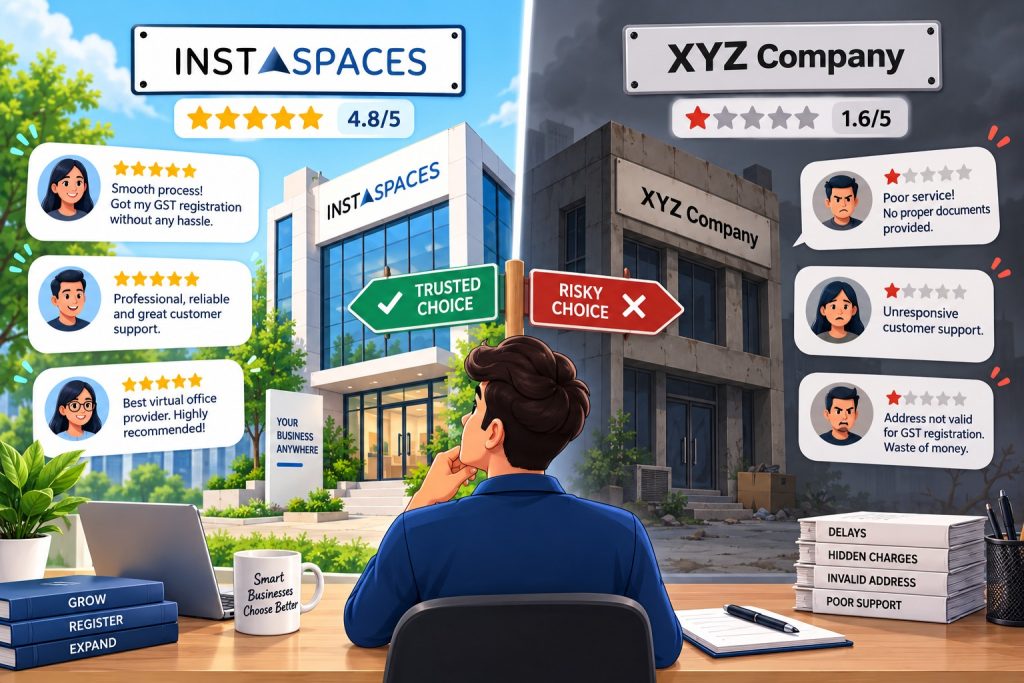
A good provider should have a good online presence. View its website, business information, contact details, office locations and customer reviews of. Verify facts on platforms. A professional website doesn’t mean a company is legitimate but if there’s no contact info, vague descriptions of services or grandiose claims, those are red flags. Well known providers like Instaspaces clearly explain their virtual office services and locations, which makes it easier for companies to know what they are getting.
5. Read Customer Reviews Carefully
Customer reviews can be a useful insight into the actual service of a provider. Don’t judge by total score. Read both the good and bad reviews and look for comments on:
- Documentation
- Customer support
- GST registration experience
- Address verification
- Hidden charges
- Refund policies
- Communication after payment
A few negative reviews are normal, but repeated complaints about the same issue may be a red flag.
6. Ask About Hidden Charges
Ask for the entire pricing structure before buying a virtual office in India.
Ask if the quoted price includes documentation, agreement charges, GST, mail handling, renewal or other services. Some providers will advertize a low initial price and then add on extra fees later.
Always ask for the full cost before you pay.
7. Don’t trust providers who make unrealistic promises
If a provider guarantees things that are ultimately under the control of government departments or third parties, be careful.
For example, without due diligence, no one can assure you of the approval of your GST application. A legitimate provider can help you with the required address and documents but the final approval is with the concerned authority.
8. Check the Agreement Before Paying
Read the terms and agreement carefully.
Ensure the contract covers the virtual office address, service duration, services offered, charges, renewal terms, and cancellation or refund policies. If you have any doubts, please do not hesitate to ask any questions.
Final Thoughts
As the virtual office address can be used for official business purposes, it is very important to choose the right virtual office provider. A little research before you buy can help you avoid documentation problems, unexpected charges and unreliable services.
Check the address, check the documents, read the reviews, understand the pricing and make sure the service is a good fit to your business requirement. A reputable virtual office provider like Instaspaces should be open about its location, documentation, pricing and terms. Doing this simple stuff can help you choose a provider with more confidence.