Table of Contents
Introduction — Cheaper home tech, faster demand
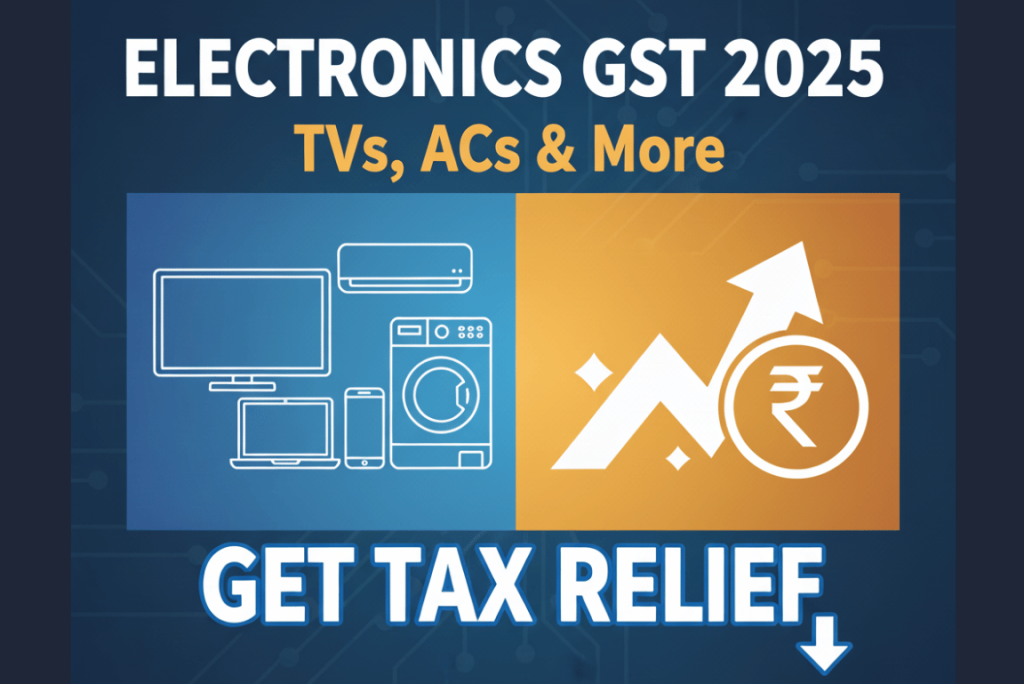
The GST 2.0 reforms that took effect on 22 September 2025 include a big win for consumers: several electronics and white goods have been moved into the 18% GST slab (down from 28% or higher). This Electronic items GST 2025 relief means TVs, air-conditioners, washing machines, dishwashers and many refrigerators are now noticeably cheaper at showrooms and online, and retailers are already seeing higher footfall.
What changed — the essentials, quickly
Under the new rules, common household electronics that were previously taxed at 28% (plus any cess) now attract 18% GST. The change covers large LED/LCD TVs (above specified sizes), split/window ACs, washing machines, dishwashers and selected refrigeration lines. To ease the transition, the government allowed manufacturers to revise MRPs on unsold pre-packed stock within a notified window.
Immediate market impact — buyers, retailers and OEMs
First, retail prices fall — manufacturers like Sony, LG and Panasonic announced price reductions (TV cuts reported up to ₹85,000 for premium models). That pushes a lot of “considering” buyers into “buy now,” especially during the festival season.
Second, retailers and distributors see faster sell-through. Lower ticket prices reduce EMIs and improve conversion rates; several dealers reported a spike in sales on day one of the change. That also ripples into higher demand for installation, extended warranty and spare-parts services — revenue streams often more profitable than the initial sale.
Third, manufacturers benefit from simpler classification and steadier production planning once the new slabs are in place, but they must document MRP revisions and update invoice systems to avoid compliance friction.
What to do now — a practical checklist for retailers & OEMs
- Update tax tables: Push the 18% GST code to POS, ERP and e-commerce tax modules; test sample invoices and e-invoices.
- Revise unsold stock pricing: If you hold pre-packed inventory, follow the government’s MRP-revision rules (sticker/stamp/online update) and keep photographic and invoice evidence.
- Train sales teams: Arm staff with simple EMI examples and a one-line explanation of how the GST cut affects the final price. Customers want clarity at checkout.
- Coordinate with finance partners: Sync with banks/NBFCs so EMI calculators and loan offers reflect the new, lower ticket prices.
- Pilot pass-through strategies: Test partial and full pass-through on a few SKUs or stores before rolling out broadly — data will tell you whether volume gains offset margin changes.
FAQs — quick answers for buyers & sellers
Q1. When did the change take effect?
Ans. The new GST structure came into force on 22 September 2025.
Q2. Will manufacturers freely revise MRPs on old stock?
Ans. Yes — authorities permitted MRP revisions on unsold pre-packed stock within the notified period; document all revisions.
Q3. Will all brands pass through the full saving?
Ans. Many leading brands announced price cuts, but pass-through varies by brand, model and market — always confirm model-level pricing with your dealer.
GST Beyond Price Cuts — supply-chain and aftersales upside
Lower GST reduces landed cost across the supply chain, enabling faster inventory turns and easing working-capital pressure. Dealers should expect more service and accessories sales as household penetration rises — opportunities that can offset tighter product margins. Manufacturers can further monetise the uplift by promoting high-margin installations, extended warranties and subscription services linked to appliances.
Further reading — act on the 22 Sep 2025 GST changes
- Apparel Over ₹2,500 Faces HIgher tax | GST 2.0 Retailer Update
- GST 2.0 Relief: How Education Sector Benefits in 2025
- New GST Exemptions 2025: Big Gains for Healthcare Sector
Lightweight regional support for service and distribution
If you’re expanding distribution or opening service hubs in new cities to meet demand, a virtual office provides a professional local address, phone handling and mail services without heavy rent. That helps with multi-state registrations, quicker supplier onboarding and local customer support — letting you invest freed capital into inventory and aftersales capacity. Explore Virtual Office options here.
Conclusion — move fast, document everything
The move of TVs, ACs, dishwashers and many appliances into the 18% GST slab creates a narrow window to capture festival-season demand. Update systems, document MRP changes, train staff, and pilot pricing pass-through to find the optimal balance between volume and margin. With clear action now, the GST cut becomes an engine for sustained sales and higher aftersales revenue.
References
- Livemint — “TV, AC, refrigerator, dishwasher to get cheaper by up to ₹85,000.”
- Moneycontrol — “GST 2.0 from Sept 22: full list of items getting cheaper.”
- Economic Times — “Govt allows manufacturers to revise MRP on unsold stock.”
- Times of India — “Sony, LG, Panasonic reduce TV prices by up to ₹85,000.”
- NDTV — “Electronics, appliances moved to 18% slab; dealers report spike in sales.”
- Other References – Times of India-1, Times of India-2, Economic Times-1, Economic Times-2, Reliance Digital, Mint-1, Mint-2
Leave a Reply