Table of Contents
Introduction – What retailers should notice first
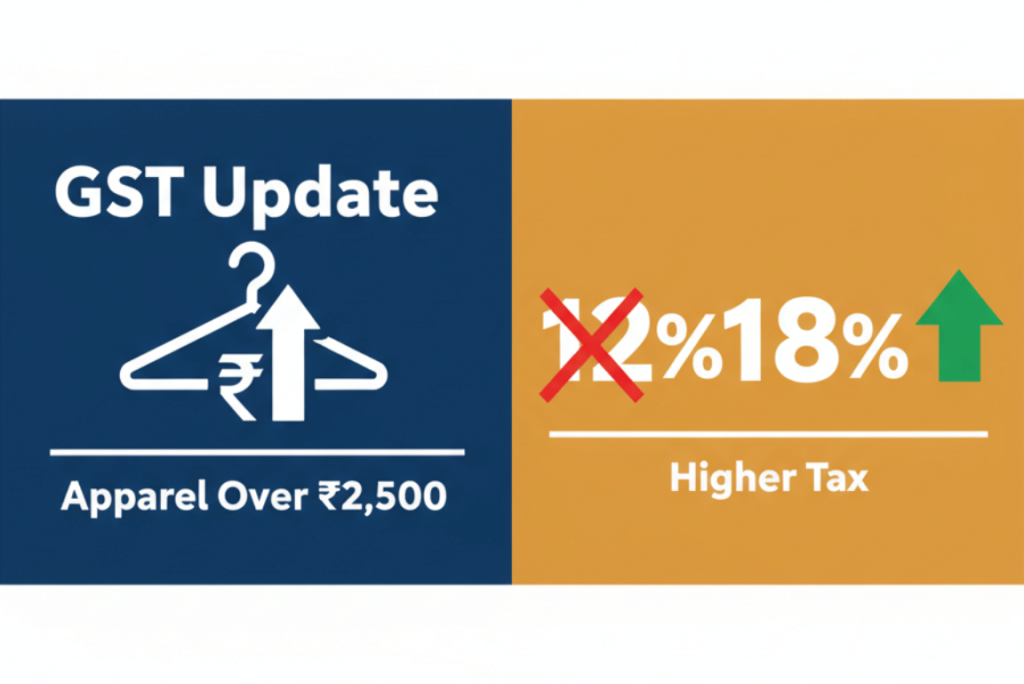
Walk into a store and the difference is already evident: customers hunt the “under ₹2,500” tag more often, staff juggle discounts, and online filters show a new priority band. The GST Council’s update — the Apparel GST hike over ₹2,500 — shifts most garments priced above ₹2,500 into the 18% slab while keeping many sub-₹2,500 items at 5%. The change takes effect on 22 September 2025 and rewrites how you price, promote and finance inventory. This guide explains what to expect and what to fix — quickly and practically.
What changed, in one line (but why it matters)
In short: many everyday clothes under ₹2,500 are now taxed lighter, and garments above ₹2,500 face a higher 18% GST. That single invoice line alters shopper choices, marketing tactics and the math behind every SKU. It’s not temporary — it’s structural — so retailers must treat it as a new operating reality, not a flash sale.
Immediate effects you’ll notice in-store and online
Expect quick behavioural shifts. Customers will increasingly filter for sub-₹2,500 offers online and ask for discounts in-store to push items into the lower slab. Low-priced fast-moving lines will gain visibility and turnover; mid-premium lines risk slower movement unless you rebalance pricing or promotions. On marketplaces, price filters and shipping thresholds will amplify these effects. For omni-channel retailers, consistency between online and in-store pricing is essential to avoid customer confusion and chargebacks.
The cash-flow wrinkle: ITC timing and inventory (what to prepare for)
Here’s the practical headache: if you bought stock before 22 Sep under the old tax setup and claimed higher input tax credit (ITC), you may sell that stock under a lower rate. That can create an “inverted duty” situation where claimed ITC is temporarily higher than output tax collected — and that ties up cash. Plan for this by forecasting working capital needs, negotiating short payment extensions with suppliers, and keeping clean, dated records of pre-change purchases so your accountant can manage transitional claims correctly.
Pricing moves that actually work (tested tactics)
You have three sensible levers. First, nudge customers toward ≤ ₹2,500 ranges with visible promotions and option bundles. Second, selectively absorb a portion of the tax on key loss-leader SKUs to sustain footfall. Third, use transparent bundle pricing: pair one higher-tax item with a low-tax essential so the average invoice looks better. Crucially, show discounts on the invoice — GST applies to final transaction value, and a visible discount can legitimately change which slab applies.
Operational checklist — what to do this week (practical & immediate)
Update POS and e-commerce tax rules so final transaction values determine slab assignment. Re-run SKU-level margin checks and mark fast-moving sub-₹2,500 lines for promotion. Document all pre-22-Sep purchases (invoices, dates, quantities) and keep them accessible. Talk to suppliers and lenders now — short-term payment flexibility can ease cash squeezes. Train staff with a simple script explaining invoice-driven GST so customers get clear answers at checkout.
FAQs — quick, direct answers
Q1. When does this start?
Ans. 22 September 2025. Update systems now; don’t wait.
Q2. If I discount a ₹3,000 shirt to ₹2,400, which GST applies?
Ans. GST is charged on the final transaction value after discount. If the invoice shows ₹2,400, the lower slab may apply — ensure the discount is recorded on the bill.
Q3. Will I lose ITC on old stock?
Ans. Not automatically — but timing mismatches can create short-term cash pressure. Keep purchase invoices and consult your tax advisor for transitional claims.
Further reading — act on the 22 Sep 2025 GST changes
- New GST Rates 2025: Complete List of 0% & 5% Goods
- GST 2.0: Small Cars & Motorcycles Get Major Tax Relief
- Impact of 40% Luxury Tax on Businesses – GST 2.0
Smarter Local Presence for Multi-State Expansion
If you’re launching into new states or scaling online, a virtual office gives a professional local address, phone handling and mail services without heavy rent. It doesn’t solve tax, but it eases multi-state admin and registration — useful if you expand rapidly to capture post-GST demand. Explore Virtual Office options here.
Conclusion — act fast, document everything
The GST shift that taxes clothing over ₹2,500 at 18% changes retail math at SKU and invoice level. Update systems, reprice thoughtfully, plan for ITC timing effects, and train teams to explain invoice logic. With the change effective 22 September 2025, prompt, documented action will protect margins and position you to capture festival-season demand.
References
- LiveMint — apparel & footwear up to ₹2,500 to 5%
- Times of India — industry reaction to clothes over ₹2,500 moving to 18%
- Reuters — winners and losers from GST 2.0
- New Indian Express — short-term fund crunch for garment retailers
- Economic Times — discounting and invoice value guidance
Leave a Reply